• Home
  • About
  • How I Help You
    • Online Courses Studio
    • Agents Estate and Lettings Bookkeeping
  • Media Studio
    • Articles
    • Podcast
    • Videos
    • Divorce Blog Posts
  • Debt Free Divorce Home
  • Resources
    • Firmer Females
    • Free Tips & Tutorials
      • Divorce Blog Posts
      • QuickBooks Online Tips & Tutorials
      • Xero Accounting Tips & Tutorials
      • Tax Free Tips – Business Allowances
    • Online Courses Studio
    • Bookshop
    • Highly Recommended
  • Book
  • Contact
    • Cookie Policy
    • Privacy Policy
    • Facebook
    • Instagram
    • LinkedIn
    • Pinterest
    • Twitter
    • YouTube

Financial Gym for Business

BUILD A BUFFER OF PERSONAL MONEY & STAY OUT OF DEBT

Archives for 2013

Avoiding Problem Customers

October 8, 2013 by Georgette Rowland Osborne

https://financialgymforbusiness.com/wp-content/uploads/2013/10/Video-17_Cashflow-tips-Avoiding-Problem-Customers_audio.mp3

Podcast: Play in new window | Download | Embed

Subscribe: RSS | More

[audio:https://financialgymforbusiness.com/wp-content/uploads/2013/10/Video-17_Cashflow-tips-Avoiding-Problem-Customers_audio.mp3]

To download the audio file to your computer, please right click on this link and choose save link as, or save target as, depending on your browser. If you would rather read while you listen or you prefer to just read without the audio or video, we have provided the full transcript further down the page for you.

Be a part of the Financial Gym Inner Circle for Free. Pop your email in the box to the right and be amongst the first to get:

  • Updates on ways to improve your day to day business money and productivity issues
  • Free video tips and tutorials
  • Downloads and templates to keep and use in your business


Transcript

DEALING WITH DEBTORS – CUSTOMERS WHO OWE YOU MONEY:

When a business ceases trading, it is not just the business that closes that is a casualty but anybody they may have owed money to.

Because of the recession, people going out of business has became much more commonplace than before, so you owe it to yourself to be vigilant and not ignore red flags that could be a sign of payment issues to come.

Some of these are:

1. Constantly paying invoices late.

While this could just be a symptom of the administration routine at your customers end, e.g. local authorities are known for long payment periods so if you do business with them it is something you knowingly take into consideration.
If the late payment is not for an obvious reason, and you are confident there is no dispute with what you supplied, then it could be, though by no means definite, that your customer is juggling bills to fit with tight cashflow.

2. They rarely pay your bills in full, making regular part payments on account.

3. Though not so common, but relevant, they send post dated cheques.

4. They send a remittance advice advising of payment online but the money does not appear until sometime later. Definitely not on or around the date of the remittance

5. Paying your old invoices only when they need to place another order with you.

6. Regularly disputing invoices and wanting refunds. This could be a sign your goods or services need improving, but if you are confident that is not the case, be wary.

7. When chasing them for payment, never being able to speak to the person who is responsible for paying you, colleagues reassure they have passed on your messages and you will be called back, but you never are.

8. One that is not so obvious but one that I have witnessed occurs when a new customer places a larger than usual order for a first time, often needing a quick turnaround.

I experienced this the first time in a company I worked with many moons ago and on further investigation (it was a very incestuous industry), I learned the potential client had fallen out with 2 previous suppliers due to late and non-payment and was struggling to fulfil their orders.

I had no intention of being the next in line so insisted on payment in advance. It is instances like that where credit checking and references can be very useful. But that is something to consider when setting up your credit control policy and procedures in the first place.

Credit control policy & procedures!

I will save that for another time.

Thank you for spending time at the financial gym. Dedicated to helping you be the financial leader in your business without having to be a financial expert.

Leave a comment, share with your contacts and …

Enjoy your day
Getting Your Customers to Pay You Quicker

September 10, 2013 by Georgette Rowland Osborne

https://financialgymforbusiness.com/wp-content/uploads/2013/09/Video-16_Cashflow-tips-Getting-Your-Customers-to-Pay-Quicker_Audio.mp3

Podcast: Play in new window | Download | Embed

Subscribe: RSS | More

[audio:https://financialgymforbusiness.com/wp-content/uploads/2013/09/Video-16_Cashflow-tips-Getting-Your-Customers-to-Pay-Quicker_Audio.mp3]

To download the audio file to your computer, please right click on this link and choose save link as, or save target as, depending on your browser. If you would rather read while you listen or you prefer to just read without the audio or video, we have provided the full transcript further down the page for you.

Be a part of the Financial Gym Inner Circle for Free. Pop your email in the box below and be amongst the first to get:

  • Updates on ways to improve your day to day business money and productivity issues
  • Free video tips and tutorials
  • Downloads and templates to keep and use in your business


Transcript

I became a director of a company many years ago that had a month end invoice routine. It was that way because there were so many invoices to produce that batching on one day became the norm and it was done by one of the directors who was time poor.

It may have solved a workload problem but it created another one in terms of cashflow.

It also highlighted poor delegation but that is a whole other discussion.

Because the invoices were sent on the 30th of each month and customers had 30 day credit terms, you couldn’t start chasing for 30 days to get the money in. So if a customer had been serviced or received goods at the beginning of the month, they were effectively getting 60 days credit. [Read more…]

How banks set a good example – Huh?

July 2, 2013 by Georgette Rowland Osborne

https://financialgymforbusiness.com/wp-content/uploads/2013/07/23_How-Banks-set-a-good-example-Huh-audio.mp3

Podcast: Play in new window | Download | Embed

Subscribe: RSS | More

After all that has been said and written how is it possible that the banks may actually have set a good example?


[audio:https://financialgymforbusiness.com/wp-content/uploads/2013/07/23_How-Banks-set-a-good-example-Huh-audio.mp3]

To download the audio file to your computer, please right click on this link and choose save link as, or save target as, depending on your browser.

Criticised for reckless lending; but who did they lend to? Well us.

When times are good, just like in business, shortfalls in one area can be compensated for in another.

However when we are faced with danger of crisis the tendency is to do exactly what the banks did and retreat and withdraw from the norm

Let me use paint a picture or scenario for you. Imagine you are a tour guide who used to take city people through the jungle to see the sights on a regular basis.  In hindsight you may consider this to be maybe a little reckless, bearing in mind the danger that lurks in the jungle and the lack of experience of the people who you are guiding. Yet you keep doing this because these crazy naive people keep trusting you to take them on the tour.

Then one day while you are out with a group, a large wild cat, pounces from nowhere and you are running for cover. You escape and find a cave to hide in but your tourists are left out in the danger zone. You know you are the only thing standing between them and getting eaten alive as you know the way out of there but you decide to stay put, what good would it do if you all got caught. And if you did manage to survive you could then help the tourists.

Only by the time you do emerge from the cave, some have been eaten alive, others injured and those that got out of the jungle were traumatised and mistrusting of you because they believe you left them when they needed you most.

Yes it is a silly example, but is not dissimilar to how the public perceives what happened between the banks and small businesses when the financial crisis of 2007 onwards struck. After years of happily taking people into the jungle; when danger hit, the banks retreated and the businesses that had no contingency faced extinction. In their case the wild cat was lack of money no longer being able to rely on the banks to get or extend loans or overdrafts.

So if the banks were such turncoats as is popular belief, why should you follow any example that they set?

Why because they taught us one valuable lesson, when your ability to make money is under threat, whether from:

  • Lack of sales,
  • Inability to work, for example if you are self-employed and get ill.
  • Economic forces like the credit crunch hitting your business
  • A downturn in interest in your product or service, think Sony Walkman.

What do you do (apart from sort out how you can improve the situation) you beef up and/or protect your assets.

What do you mean by that George?

Well for most of us, it is the items that make up your balance sheet. Don’t get too hung up on what a balance sheet is for now, I know it is just another thing that is a pain to get your head around.

I will demystify that subject in another video so don’t worry.

For now; I just want you to understand that one of the things it shows is what your business actually owns that may or may not be worth money if you tried to sell them. The balance sheets also shows you what cash you have left over at any point in time. If sales & cash flow are under pressure; having reserves to fall back on could well help you ride out storms.

As with most small businesses you may not own lots of property, valuable plant and machinery, run a vintage wine cellar, etc so your balance sheet reserves may well be mainly made up of cash in the bank and maybe your two year old all-in-one printer.

If you rely on borrowing, whether via an overdraft, loans or credit cards, then having cash sitting in the bank is maybe a distant dream at the moment, but it is what is needed.

And this finally is what the banks, though unintentionally showed us By tightening their lending they sat on the money. Security became the focus. Savvy business owners of course generating income but keep some back for contingency and investment.

Our much clued up older generation would call it “putting something aside for a rainy day”

The trick is to be able to do it even when we need the money for other things. The majority of us spend what we earn first and see if there is anything left. But the odds are very strong that there will always be something that you need to pay for even when you are doing really well, so getting into the habit of moving money out of the way before you spend will be one of the things that will build your financial foundations.

In future months I will give you some pointers, tools & techniques that you can use to do this for yourself.

And if you sign up for my freebies, you will be one of the first to be notified when they become available.


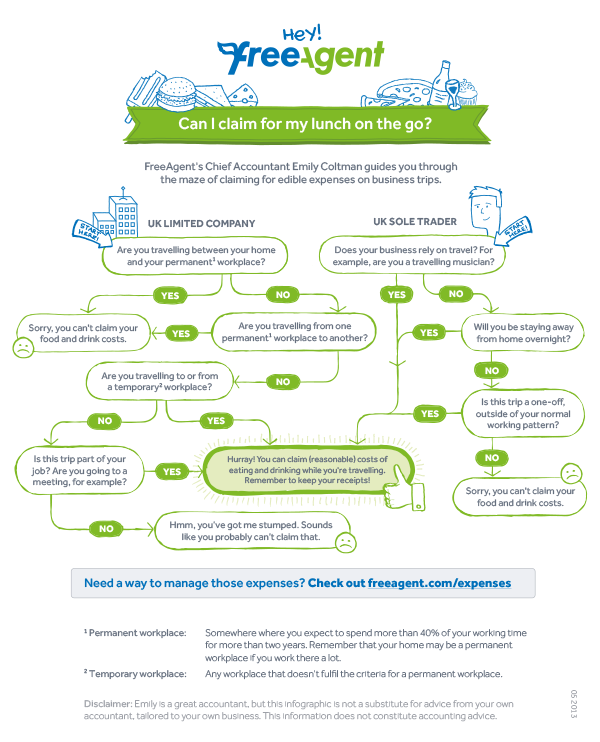
Claiming for business food and business travel

June 18, 2013 by Georgette Rowland Osborne

One of the constant conversations I have with my clients is whether or not they are allowed to claim for certain expenses.

It is assumed that just because they give my team a receipt that everything is hunky dory.

The team at FreeAgent have put together a simple little infographic showing the most common scenarios and the difference between claiming if you are a limited employee as opposed to a sole trader.

And if you want to know more about FreeAgent, click this link which entitles you to a discount off standard prices.

View the full image at FreeAgent

I am a sole trader – what name do I use to invoice customers?

May 29, 2013 by Georgette Rowland Osborne

When you are a sole trader or self-employed the rules about what you name your business is pretty much up to you, but I would suggest you leave Nike alone.

Even so the name you trade with does have some implications that could cause you problems if you are unaware.

Watch today’s video tip to find out a few of them and what you can do to keep problems to a minimum.

I was working with someone recently and I noticed that the format of their sales invoices were inconsistent.

I TACTFULLY mentioned that I noticed the invoices seemed to change and asked them why that was as it was affecting how we did their bookkeeping.

It was another lesson to me in not assuming people know something just because it seems simple to you.

If we call the person Jane Smith and she has given her business the name Smith & Co Consulting. Legally her full business name would be: Jane Smith trading as Smith & Co Consulting. Because she and the business is one and the same – unlike with a Limited company where you are treated as separate to the company, whatever name she uses it still relates to her.

However the problems come if you are not consistent in your use.

1. If Jane was using her personal bank account for business transactions, she would have to make sure it was clear to her customers that any cheques to her would have to say Jane Smith and not Smith & Co otherwise she cannot bank it. – I know cheques are being phased out but they have had a stay of execution and many people still do use them regularly.
2. If she is using a business account when she opens the account the bank needs to know that she is trading with a business name otherwise if she receives payments with the business name she again cannot bank it. However if this is done properly the business account option is the most flexible.
3. If she registers for VAT, it is advisable to register in the trading name that she uses all the time. You need to send supporting documentation when registering for VAT so whatever you already have is ideal.
4. Even though she and the business are one. Paperwork with the business name on it does make it easier to justify and track transactions that were wholly business related to avoid having expenses disallowed because they could be assumed to be for personal use.

That’s if for this installment.

Business Record Checks – Would YOU Pass an Inspection

April 19, 2013 by Georgette Rowland Osborne

What exactly is Business Record checking and how could it affect your business.

Please bear in mind that regulations and procedures change at the Revenue all the time, so the information here may change.

This video is for the people who should read their Tax and Government bulletins, but get a migraine just looking at them.

And for those of you that want to take action before action is taken against you. See below for a great tool to have in your business.

[youtube]http://youtu.be/OWMYvdLJqtA[/youtube]


Please bear in mind that regulations and procedures change at the Revenue all the time, so the information here may change.

Well the Revenue introduced the record checking in 2011 as a way of ensuring that small to medium sized business owners are keeping adequate records to support any returns they make, such as their tax returns. They already do these for VAT.

So what is different about these checks?

Well in the past when you were contacted by the revenue to arrange a visit to inspect your records it was usually triggered by something. For example if your VAT Return said you were entitled to a refund, the Revenue could request an inspection to verify your figures.

Business record checking however is based on businesses the Revenue think may be more risky than others, and so target – for want of a better word – those. Prime examples are heavily cash-based businesses, particularly the trades, consultants, restaurants and take-aways, to name a few.

A pilot was run in 2011 which brought up some concerns from industry experts, so the Revenue suspended the checks until late 2012 when they resumed them again. For those hoping it may fade away. During the pilot scheme the Revenue found issues with 36% of business owners visited and reported that of those 10% were serious enough to warrant a further visit. So they will not be going away any time soon.

How does it work and what happens?

FIRSTLY

  • HMRC contact you, usually in writing, to arrange a time to ask you questions over the telephone about your bookkeeping records. This interview is usually around 15 minutes
  • Based on the call the officer will come to one of three conclusions:

1) No further action is required

2) You could do with further guidance, so your details will be passed to their Education & Support Team to provide you with help on tidying up your records.

Or

3) They are sufficiently concerned that your records are at risk of being inadequate and you require a visit from an inspector.

Your details are then passed to their booking team to arrange a convenient time for this.

You will be told during the call which one of these actions applies to you.

What if you are told you need a visit?

THE VISIT

 The face to face inspections are usually around two hours, but I have had this estimated with visits in the past and it is not unheard of for an officer to be at a premises for many hours if they find enough cause to keep looking.

The officer will:

  • Ask you about your business and how it is run
  • Take a look how you do your bookkeeping in general
  • Inspect a period of bookkeeping, around  months to get a snapshot of actual records

From this they will make conclusions and decide whether further action is needed, and if so what that needs to be.

As with the introductory phone call you will be told during the visit what the next stage is, if any, and this is confirmed in writing.

What are the next stages?

OUTCOMES

  1. If all is well, that is the end of it and this is confirmed by letter
  2. If there is room for improvement you will be told what needs to be dealt with to bring your records up to scratch and given a deadline in which to do it, generally no more than 3 months. You may also be liable to pay a record keeping penalty.
  3. At the end of the deadline you get a follow up visit. If you have done as asked as your records pass scrutiny; your penalty will be removed and you no longer have to pay it.
  4. However if the officer still is not satisfied you can be fined anything between £250 and £3000, the higher penalty applies if you have destroyed records that you should still have.
  5. You are then put on the schedule for another visit in two years time.
  6. As if that is not enough, you may also be referred to the tax return investigation team to carry out their own checks because the lack of good records is a red flag that the Returns need looking at also.
  7. And they will also check whether you should be registered for VAT, PAYE and CIS if you have not already done so.

If this is daunting to you, speak to your advisers to make sure you are where you should be. Your accountant, if they are involved in your day to day. But this is really the forte of your trusty bookkeeper.

Thank you for spending time at the financial gym. Dedicated to helping you be the financial leader in your business without having to be a financial expert.

And why don’t you leave a comment, share with your contacts, customers and friends

Oh and of course here is the link for the tool I mentioned above. If you don’t use anything like this, or your current systems are not supporting you, give this a a try.  Click Here

Popular Misconceptions about Bookkeepers & Accountants

February 22, 2013 by Georgette Rowland Osborne

5 ways that being misinformed can lead to poor choices

[youtube]http://youtu.be/q3RqjgLcses[/youtube]

Come with me a little trip where I want to clear up a few common misconceptions about business finances and bookkeeping and how it may affect you and your business.

As much as I would like to think otherwise, I am under no illusion that for most business people, doing bookkeeping is on a par with clearing up after a party.

Taking the actual doing of it out of the equation; I have found that much of the resistance comes from why you need to do it rather than just what you need to do.

Remember. Numbers tell a story. That is why a bookkeeper or accountant can look at your figures for the first time and see things about your business that you may have missed or thought only you knew about. And if we can do it, the tax man definitely can.

Misconception 1 – My business is too small

When your business is small or you are a sole trader, the balance of the bank account and what is in your head can become the bench marks by which you measure how well things are going.

This is perfectly understandable when you are a start-up as there may be very little activity. Nevertheless the sooner you find a way to accurately keep track of what is going on with your money the more likely you are to stay out of trouble.

And your business simply cannot grow and survive if you don’t.

Misconception 2 – Bookkeeping is not as important as Year End Accounts

If you think of your financial framework in terms of the human body:

  • You are the heart
  • Sales is the lifeblood pumping around keeping everything going
  • Accounting is your annual check to see how healthy you are overall
  • Bookkeeping is the brain taking note of all the activity on an ongoing basis looking for signs of trouble and the reasons for good health.

How many lives have been saved because of early diagnosis, your business is no different.

Misconception 3 – I can do it myself

And you know what, that may well be true.

Ignoring costs for the moment, why are you?

Is your business doing so well you have spare time to devote to recording historical transactions?

If not how is this going to bring in sales?

And if your business is doing really well, I bet it didn’t happen because you did bookkeeping.

Successful entrepreneurs are totally on top of their financial figures, but that does not mean they have any idea how those figures came about. They just want the data to run their business the best way they can.


And not forgetting the time it takes if you are not qualified or experienced. I recently heard a photographer say “there may be camera on your smartphone, but it doesn’t mean you really know how best to use it” or something along those lines. But you get my drift.

Misconception 4 – Accountants are qualified Bookkeepers are not

While qualifications are a standard to measure the expertise of a financial professional, it is not the only benchmark. It is presumed that to be called an accountant you must have a qualification.

Did you know that at present anyone can call themselves an accountant in this country whether they have qualifications or not. There is no obligation to be part of any professional body or take any exams if you choose not to.

However; of course most choose to do so. Bookkeepers who qualify with the Institute of Certified Bookkeepers for example face a number of courses and examinations before they qualify at various levels and are prohibited from offering a service to clients that they have not successfully passed the exam for.

Many bookkeeping professionals are certified to offer Tax Returns and Final accounts as well as the standard bookkeeping and payroll services:

And there is no substitution for someone with a wealth of real life and varied experience; they are worth their weight in gold to your business.

Misconception 5 – I need ongoing advice and support but bookkeepers only enter data

Using myself as an example:

When it comes to entering data, I am certainly not shabby when it comes to speed and accuracy. I have people in my team who are qualified accountants who still go “how did you do that?”

But ironically, the entering of data has become a means to an end because my relationships with my clients have become more about hand holding and being a means of support than I ever imagined.

The entering of data is just the tool we use to do it.

What the person really wants is:

  1. to understand the story that the data is telling about their business
  2. know what to do or who to talk to based on that story
  3. know they are not alone in dealing with that side of things

I accept there are people in the business who are focused on transactions as opposed to what you need at the other end, but that is where how good you are at finding the right supplier takes on a whole new significance.

I will save that for another time.

If you have any questions or comments feel free to share them with us.


How can I pay my VAT and make a little money from it – Legally

February 4, 2013 by Georgette Rowland Osborne

As part of my GYM (Grasping Your Money) series let me share a little tip on how you can actually get HMRC to let you keep VAT you have collected.

[youtube]http://youtu.be/MA19w71Air4[/youtube]

If you dread VAT Return time, don’t despair. VAT can even be fun.

Alright maybe that is pushing it, but it can at least be less daunting.

Firstly decide that VAT funds were never yours to begin with. If you make a sale and charge £2000 and you add VAT, using the current 20% standard rate that would add £400 to your invoice.

Many business people collect that £2400 bank the whole lot and it forms part of their cash for expenses. If you accept that your money is the £2000 for the sale only, then you need to move the £400 out of the equation.

Set up a separate bank account and move the VAT portion of every sale you make into it.

So far so good; but how does that make me money? I hear you say. Bear with me.

Firstly the most obvious advantage is that when it does come time to pay your VAT, you have the money available and you are not panicking about how you are going to pay it.

Secondly the chances are that your VAT liability in any period will be less than the amount you collected, because it will be reduced by the VAT on any purchases you made. So if you have set aside the original £400 VAT, and the VAT you owe for the period is £300, you have saved £100.

Leave it where it is, or better still shift it to a deposit or savings account and use it build up your cash reserves. Watching money grow is a past time I could never tire of.

That assumes you are on a standard VAT scheme and you make enough purchases to offset against your sales. But even if you don’t, your VAT liability will always be no more than the 20% (or whatever the rate of the day is) anyway, so no more late payment warnings or surcharges.

Even better! If your turnover is less than £150,000 there is potentially even more money you can claw back. For those businesses, there is a VAT scheme called the Flat Rate Scheme (FRS) which enables businesses to apply a lower percentage rate to the amount they have to pay over to HMRC.

HMRC must enrol you and the rate varies depending of what type of business you are in. It is particularly suited to the self-employed, consultants, and professionals. The key is that while you still add the full standard VAT rate to your sales you are only liable for the lower percentage when it comes time to pay your VAT.

It is primarily designed to simplify VAT calculations for small businesses because you only have to account for the VAT on your sales. VAT on expenses cannot be claimed under the scheme (except for assets over £2000) so the lower rate is designed to compensate for this.

Let’s assume HMRC have agreed your rate under FRS is 13%; using our £2000 + VAT, you will still invoice £2400 gross, but if on your scheme you are only liable for 13%, you will again collect £400 VAT, but you will only pay £260 to HMRC and retain the £140 difference.

The disadvantage comes if you have a high percentage of supplier bills and expenses from which you regularly claim or you receive regular refunds from HMRC anyway; then you may be better off on the standard VAT scheme. And remember, over £150,000 turnover makes you automatically ineligible.

Also because the retained amount adds to your profit, there is self-assessment tax and corporation tax to consider. But this is still only a proportion and the rest is growing in your account.

This one may not make you rich, but you can use it unearth “hidden” cash, as well as keep the tax man at bay.

Please feel free to leave any comments and share this blog with anyone who you believe may benefit.

Better still if you are able to give it a try, why not let me know how you got on.


The Biggest Shake up to payroll in years – Are you ready?

January 22, 2013 by Georgette Rowland Osborne

Introducing RTI

[youtube]http://www.youtube.com/watch?v=KkN7tp1QAUM[/youtube]

If you employ staff, even if it just you as one employee, you will are affected by one of the most radical changes in your reporting and filing obligations for many years.

Up until 2013 you were required to calculate your payroll, pay your staff, and pay the payroll taxes each month (or every 3 months) for some.

Nothing else needed to be done until the end of the tax year when you, your bookkeeper or accountant then completed an Employer Annual Return (P35 as they are commonly known) which had to be received by the Revenue before 19th May.

Any money that was due had to be paid up by that date also. The loophole was that if you were struggling to pay the tax each month, as long as something was paid, the Revenue was none the wiser it was behind, until they received the Employer Annual Return. And as long as you had paid everything up to date by then you were usually ok.

Now for the shakeup

From April 2013 you are required to not only calculate payroll, pay staff, and pay payroll taxes but IN ADDITION you must inform the revenue (i.e. file a return effectively) each time you pay someone. Hence the name: Real Time Information (RTI).  So no more Annual Returns.

Why are they doing this?

  1. The intention is to modernise the Pay as you earn system to reflect how we live today.
  2. With people moving jobs more regularly and having more than one job the chances of paying the wrong tax was high
  3. Though not advertised as such, let’s tell it like it is, the Revenue needs to find ways to improve its own cashflow and Real Time Information will make accurately identifying outstanding payroll taxes easier.
  • For those that delayed payment regularly this could cause a cash flow headache so being on top of your money is going to be even more crucial.
  • Your software also needs to be RTI ready to enable you to do the regular returns.

If the thought of this leaves with a major migraine then a good bookkeeper is what you need.

If you know people who employ staff, send them the link to this page, they may not be as clued up as you and not knowing is not a defence as we know.

Thank you for spending time at the financial gym. Dedicated to helping you be the financial leader in your business without having to be a financial expert.

Leave a comment and if you haven’t already, get my free downloadable tips booklet and access to other free stuff & resources.

Enjoy your day

Propping up your business with personal money – A case study

January 13, 2013 by Georgette Rowland Osborne

[youtube]http://www.youtube.com/watch?v=ZKlQ4kgOBY8&list=PLhWR6eymM1Htkp0DhAws0LF1vpuFIf6d1&index=3[/youtube]

Despite sales increasing many business owners find they still have to inject their own money to cover monthly expenses longer than they had planned; and cannot understand why if they are making more money.
Here I use a real life example to illustrate how this can happen

Testimonials

  • Andy PetersonAndy PetersonIntuit UK QuickBooks

    "Thanks for being one of my favorite partners this year. As one of my US colleagues would say – ‘You’re awesome!’

  • Steve SweetloveSteve SweetloveDirector - Right Hand HR

    “Dear Georgette, further to the work you carried out for one of my clients; I am writing to express my gratitude. The client was the first to admit that since incorporation the bookkeeping had been close to non-existent.

    Compliance was causing him anxiety as the industry his company trades in is tightly regulated.

    I received a call in which he expressed how relaxed he felt now that he was in good hands. I will not hesitate to refer you to family, friends and colleagues, as well as passing future clients to Precision/Financial Gym.”

  • Lillian KyeiAccountant

    I have tapped into Georgette Rowland’s expert knowledge; especially in relation to Estate& Letting agency accounting procedures. She is very efficient and reliable, readily to offer advice and help.
    I would highly recommend Georgette & Precision Bookkeeping for all your bookkeeping requirements and you will not be disappointed

  • Michelle HolmesMichelle HolmesThe Energetic Activist

    Georgette Rowland Osborne!!! You ROCK ROCK ROCK!!! Thank you sooooooo much! I freaking LOOOOOOOOOOOVE you Mrs! You are freaking ridiculously awesome! I need to broadcast you to the world!

  • Suzannah Nichol MBESuzannah Nichol MBEChief Executive Build UK Group of Companies

    "Our growth as a business has been fantastic and I truly meant it when I said you played a major part in that growth. Many many thanks"

  • Shelly CollinsShelly CollinsDiveristy Expert & Director of Just Resources International

    "Thank you Georgette, you changed my business and turned my life around!” 

  • Judith HollowayJudith HollowayParenting Expert & Property Coach

    “Georgette doesn't mince her words and gets straight to the point, with lightness and love - so refreshing!" 

  • Home
  • About
  • How I Help You
  • Media Studio
  • Debt Free Divorce Home
  • Resources
  • Book
  • Contact

© 2026 · Pretty Creative WordPress Theme by, Pretty Darn Cute Design